
ECC Instructor Further Explores Early Language Development at Harvard
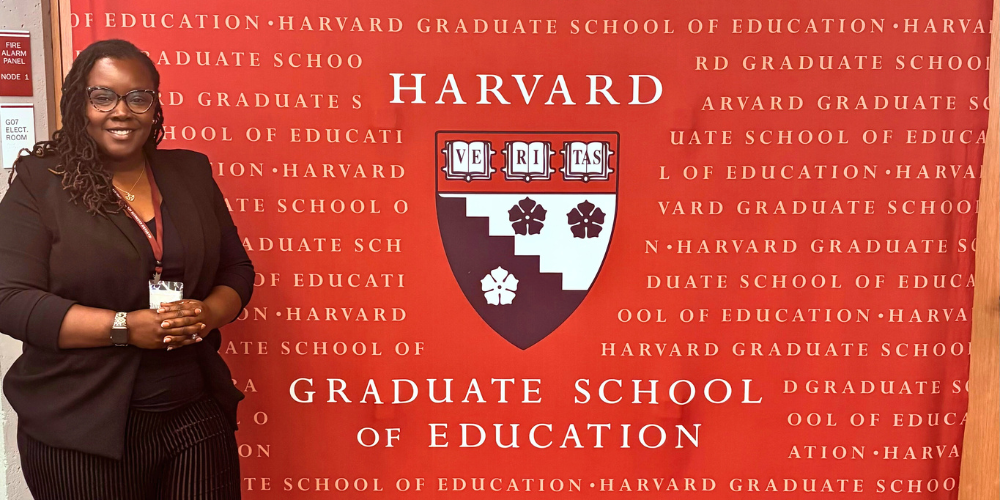
麻豆视频在线观看 early childhood instructor, QuaShawnda Everett
When 麻豆视频在线观看 early childhood instructor, QuaShawnda Everett, first learned about Harvard University鈥檚 training on early language development, she was a little apprehensive. Training at the prestigious Harvard University would be exciting, but it would be Everett鈥檚 first time flying by herself, the first time she would travel out of state alone, and her first time visiting the university. The thought of trying to maneuver around such a large campus was also intimidating. But after the Bertie County native researched the opportunity, discovering that everything was in walking distance, the apprehensiveness subsided. Once she learned more about the training, she couldn鈥檛 contain her enthusiasm and was ready to arrange her travel plans for Cambridge, Mass.
The topic of the Harvard program was the Language-Rich Learning Environments and Experiences: Increasing Opportunities-to-Learn for Today鈥檚 Young Children. According to Harvard鈥檚 Graduate School of Education webpage, the program 鈥渆xplores the latest science of early language development among monolingual and multilingual learners.鈥�
鈥淏ecause I teach a language and literacy class, and we basically talk a lot about language in a lot of the classes I teach, I was excited about the topic,鈥� recalled Everett. 鈥淚 knew I could learn something and bring back some type of resources to be able to share with the students.鈥�
As an early childhood instructor, Everett is responsible for educating adults working to attain credentials for teaching children or engaging in another aspect of the early childhood field.
That鈥檚 why the Harvard program seemed like a perfect fit for the instructor, in her third year at ECC. Participants learned about the importance of early literacy in young children, including the introduction of books, content posted in the classroom, and communication between the teacher and the children.
鈥淭hey also discussed the introduction of different words and sophisticated language in children鈥檚 vocabulary, asking a lot of wh-questions (who, what, when, where, why, how) to expand children鈥檚 vocabulary and allowing them opportunities to communicate,鈥� said Everett. She was also enthralled by the fact that the presenters of the training were actual professors at Harvard University. The added bonus was that Harvard offers an early childhood initiative program, providing graduates with a certificate in early childhood leadership.
Everette鈥檚 learning was reinforced during a break-out group session where she and her team were presented with a case study. Following presentations from the instructors, Everett communicated with her group members from places like Thailand, Hawaii, Brazil, Canada and New Zealand. Their assignment was to provide feedback on some of the road blocks that would hinder them from implementing these language-rich environments.
Supporting multilingual learners is also an aspect of these language-rich environments.
鈥淎ll of these different children are coming into the classroom,鈥� recognized Everett. 鈥淪o, how can we make the environment friendly for all of these different languages, and how can we incorporate the parent and the family as a whole so that everybody is learning.鈥�
Everette says the training was stimulating. While the significance of literacy for children and early brain development was all a refresher for the former elementary school teacher, she was most excited about the resources that can be used in her classroom and the strategies she learned to support children鈥檚 emerging language skills.
鈥淭he most interesting to me was the multilingual component,鈥� shared Everett. 鈥淲hen you have all of these people you have to communicate with and you don鈥檛 know their language and they don鈥檛 know your language, that was what stuck out to me the most.鈥�